GW Micropropulsion & Nanotechnology Lab
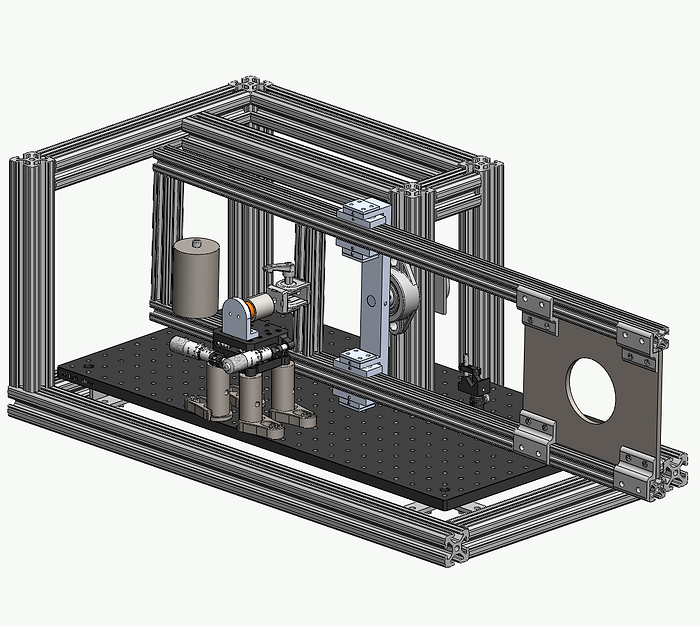
As a summer research intern in the GW Micropropulsion and Nanotechnology Lab, I designed and built a scalable torsional thrust stand for characterizing small-scale electric propulsion systems — primarily the lab's μCAT plasma thrusters. The stand measures thrust from the micronewton range up to Newton-level, with modular mounting so different thrusters can be tested on the same platform.
Plasma micro-thrusters produce forces far too small to measure directly with a load cell — a torsional balance is the standard approach. The thruster mounts on one arm of a balance suspended on a torsion pivot; thrust rotates the arm, and the deflection maps back to force. The design brief was scalability: one stand that could cover everything from a single μCAT prototype to larger propulsion packages, without rebuilding the balance for each test article. Modular mounting interfaces let us swap thrusters and counterweights while keeping the measurement path unchanged.
The stand's previous calibration method used electromagnetic combs, which could only apply forces up to about 30 μN — anything beyond that range had to be extrapolated, which undermines confidence in the data. I integrated a voice-coil calibration system in their place. Voice coils apply a known, controllable force directly, and the new setup extended the directly-calibrated range from 30 μN to 1.5 N — roughly a 50,000× expansion — eliminating extrapolation entirely.
Electric propulsion only fires in vacuum, so thrust stand testing will take place inside the lab's high-vacuum chambers — the test campaign is planned but hasn't run yet. I already operate those chambers for other lab work, including pump-down procedures and leak checks. Alongside the thrust stand build, I collaborated on fabrication of the μCAT thruster prototypes themselves, streamlining the manufacturing process to cut build time by roughly 30%.